WHITE RABBIT LABS

FOR RESEARCH PURPOSES ONLY · Not for human or animal consumption

Explore White Rabbit

Categories: , ,

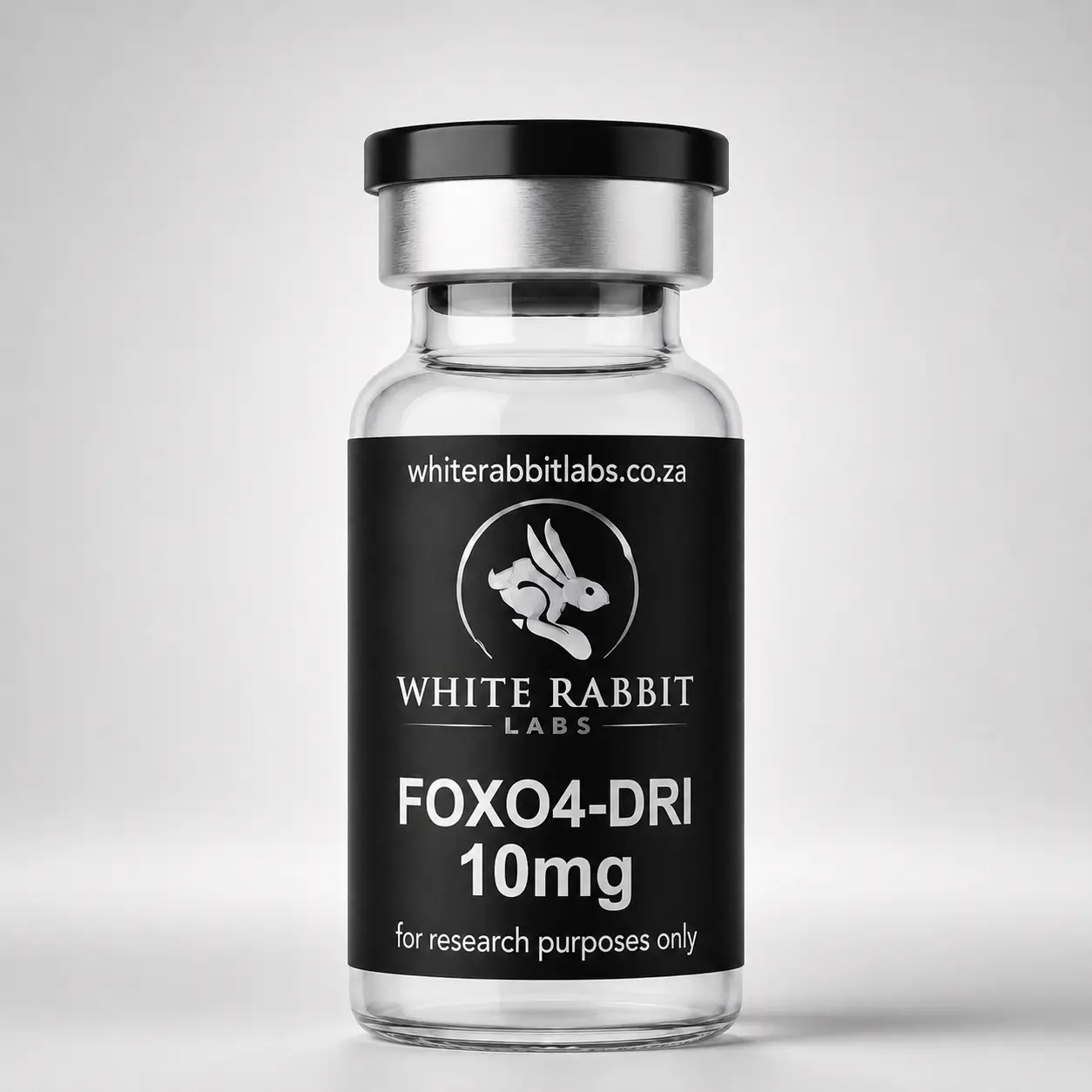
FOXO4 -DRI 10MG

8 in stock

R2 450,00

8 in stock

Categories: , ,

Description

FOXO4-DRI 10mg is a research peptide supplied by White Rabbit Labs for controlled laboratory studies involving FOXO4-p53 signalling, senescent cell models, apoptosis pathway research, and cellular ageing-related studies.

FOXO4-DRI stands for Forkhead Box O4 D-Retro-Inverso peptide. It is a synthetic, cell-penetrating peptide designed for research into the FOXO4 and p53 interaction, a pathway commonly studied in relation to senescent cell survival. Research literature describes FOXO4-DRI as a peptide that can disrupt the FOXO4-p53 interaction in senescent cell models, which may allow p53-related apoptotic pathways to be studied under controlled laboratory conditions.

In laboratory settings, FOXO4-DRI may be relevant for researchers investigating how senescent cells maintain survival signals, how apoptosis pathways are regulated, and how peptide-based compounds interact with intracellular protein-protein signalling mechanisms. It is often explored in controlled models connected to senescence-associated pathway research, p53 signalling, BAX and caspase-related apoptosis pathways, cellular stress response, and ageing-related cell biology.

Because FOXO4-DRI is associated with senolytic peptide research, it should be positioned carefully as a laboratory research compound only. These research areas are provided for scientific context and must not be understood as anti-ageing, rejuvenation, tissue repair, longevity, disease treatment, or personal-use benefit claims.

FOXO4-DRI 10mg is supplied in lyophilised vial format to support controlled laboratory handling, storage, and preparation according to appropriate research protocols.

Research Context

FOXO4-DRI may be relevant in laboratory studies focused on:

  • FOXO4-p53 signalling research
  • Senescent cell survival models
  • Apoptosis pathway research
  • p53-related pathway studies
  • Cellular ageing research models
  • Senescence-associated secretory phenotype research
  • BAX and caspase-related signalling models
  • Intracellular protein-protein interaction studies
  • Cellular stress-response research
  • Peptide-based senolytic research
  • Ageing-related cell biology

These research areas are provided for scientific context only and must not be understood as anti-ageing, rejuvenation, longevity support, tissue repair, disease treatment, cosmetic improvement, or any health benefit claim.

Important Notice

This product is supplied strictly for laboratory research purposes only. It is not intended for human or animal consumption, injection, topical use, anti-ageing use, rejuvenation, longevity support, tissue repair, medical treatment, diagnostic use, cosmetic use, or any form of personal use.

White Rabbit Labs does not provide dosing, administration, application, treatment, anti-ageing, longevity, or personal-use guidance. Buyers are responsible for ensuring that this material is handled only in a suitable research environment and in line with applicable laws, safety standards, and internal laboratory procedures.
What It Is

FOXO4-DRI (Forkhead Box O4 D-Retro-Inverso peptide) is a lab-made synthetic 46-amino-acid cell-penetrating peptide designed as a targeted senolytic. It’s a specially modified D-retro-inverso version of a fragment from the FOXO4 transcription factor, created to selectively eliminate senescent (“zombie”) cells that build up with age and drive chronic inflammation and tissue decline. Developed in 2017 from academic work at Erasmus University and later explored by companies like Cleara Biotech, it remains strictly investigational/research chemical.

How It Works

Think of FOXO4-DRI as a “zombie cell assassin.” It exploits a specific survival mechanism that senescent cells rely on, triggering their self-destruction while leaving healthy cells untouched.
How it works (super simple):
• Enters cells and disrupts the interaction between FOXO4 and p53 proteins (senescent cells depend on this binding to stay alive).
• This frees p53 to trigger apoptosis (programmed cell death) via BAX/caspase-3 pathways — selectively in senescent cells only.

Observed Benefits

Main benefits (strongest from mouse and in vitro studies):
• Senescent cell clearance — removes inflammatory “zombie” cells that accelerate aging and disease.
• Tissue rejuvenation — improves vascular function, delays vascular aging, enhances cartilage repair (chondrocytes), restores kidney function, and improves Leydig cell testosterone production in aged models.
• Reproductive support — better spermatogenesis, sperm quality, and testicular microenvironment in old mice.
• Bonus signals: potential help for osteoarthritis, pulmonary fibrosis, and overall anti-aging by reducing senescence-associated secretory phenotype (SASP/inflammation).
In short: It clears the damaged cells that drive aging, potentially restoring youthful tissue health at the cellular level.

Possible Side Effects

FOXO4-DRI shows an excellent short-term safety profile in animal and in vitro studies — no major toxicity reported.
In preclinical work: No observable adverse effects or organ damage; highly selective for senescent cells only.
Mild/rare effects (theoretical or anecdotal from research use):
• Injection-site irritation (redness, mild swelling).
• No systemic issues documented in models.
Bigger caveats:
• Zero large human safety data — effects in people are unknown.
• Theoretical risk: p53 pathway involvement could have off-target effects (unproven).
• Real-world danger: unregulated products may be impure or incorrectly dosed.
Bottom line: Appears very clean and selective in research settings, but we have no idea how it behaves long-term in humans — pure experimental territory

Reconstitution, Dosage and Cycling (Research Only)

No official guidelines exist (investigational only), so these come from preclinical protocols and anecdotal/clinic research use.

Method of Administration: Subcutaneous into fatty tissue.

Reconstitution: 2ml Bac water into single 10mg vial. See Reconstitution Guide.

Dose: 500mcg daily, therefore 10 units or 0.1ml on a 1ml syringe. Use peptide calculator for alternative dosage.

Course: 20 doses

Cycling: Repeat every 3 months for maintenance or as needed.

Tip: Reconstitute with bacteriostatic water; store in fridge. Use insulin syringes and sterile technique. Start very low and monitor with bloodwork if ever used under supervision.

Fun Facts

• “Zombie cell killer” pioneer — one of the first peptides shown to selectively destroy senescent cells (the inflammatory “zombie” cells that accelerate aging).
• D-retro-inverso superpower — the special D-amino-acid mirror-image design makes it super-stable and resistant to breakdown in the body.
• p53 hijacker — it cleverly frees the tumor-suppressor p53 inside senescent cells so they commit suicide — without harming healthy cells.
• Testosterone reboot in mice — cleared senescent Leydig cells and boosted natural testosterone in old male mice.
• Cartilage cleaner — removed senescent cells from human chondrocytes in lab studies, hinting at joint-repair potential.
• Still in play — companies and labs are still working on it in 2026 (Cleara Biotech and others) even though it never became a drug.
• 46-amino-acid precision — long for a peptide but engineered to penetrate cells and hit its target with laser-like specificity.

Citations and Sources

Human data is extremely limited (no large RCTs; mostly preclinical mouse/in vitro). Here are the strongest:
1. Baar et al. (2017) Cell (landmark paper): FOXO4-DRI selectively kills senescent cells by disrupting FOXO4-p53 interaction, restoring tissue function in aged and chemotherapy-damaged mice.
2. Huang et al. (2021) PMC: FOXO4-DRI selectively removes senescent cells from in vitro expanded human chondrocytes (cartilage model); improves potential for tissue engineering.
3. Zhang et al. (2020) Aging: FOXO4-DRI alleviates age-related testosterone insufficiency by targeting senescent Leydig cells in aged mice.
4. Li et al. (2024) Experimental Gerontology: FOXO4-DRI improves spermatogenesis in aged mice by reducing SASP from senescent Leydig cells.
5. Hu et al. (2025) Frontiers in Bioengineering: FOXO4-DRI regulates endothelial cell senescence via p53 pathway; improves vascular function and delays vascular aging in models.
6. Fight Aging! summary (Feb 2026): Ongoing research interest; still preclinical with companies like Cleara Biotech exploring FOXO4-p53 targeting.
7. Particle Peptides review (2025–2026): Mechanism, senolytic action, and tissue-specific benefits (cartilage, reproductive).
8. Wikipedia / mechanism overview (2026): Synthetic D-retro-inverso peptide; blocks FOXO4-p53 to induce apoptosis in senescent cells only.
9. BiohackNow / clinic overviews (2026): Anecdotal research protocols; potential for cellular renewal but emphasizes investigational status.
10. Revolution Health summary (2025): Senolytic potential for age-related diseases; no human approval or large trials.
Takeaway: Promising mechanistic and animal data for senolytic effects, but we desperately need human trials.

Our Take

Fascinating Compound. A must for longevity.

Disclaimer

Important disclaimer upfront: FOXO4-DRI is NOT approved by the FDA (or any major agency) as of 2026. It has no large human clinical trials — data comes almost entirely from mouse models and in vitro studies. It is a research chemical only; compounded versions are unregulated and carry contamination risks. Long-term safety is unknown. It is banned by WADA. Always talk to a doctor — this is not medical advice