WHITE RABBIT LABS

FOR RESEARCH PURPOSES ONLY · Not for human or animal consumption

Explore White Rabbit

Categories: , Tag:

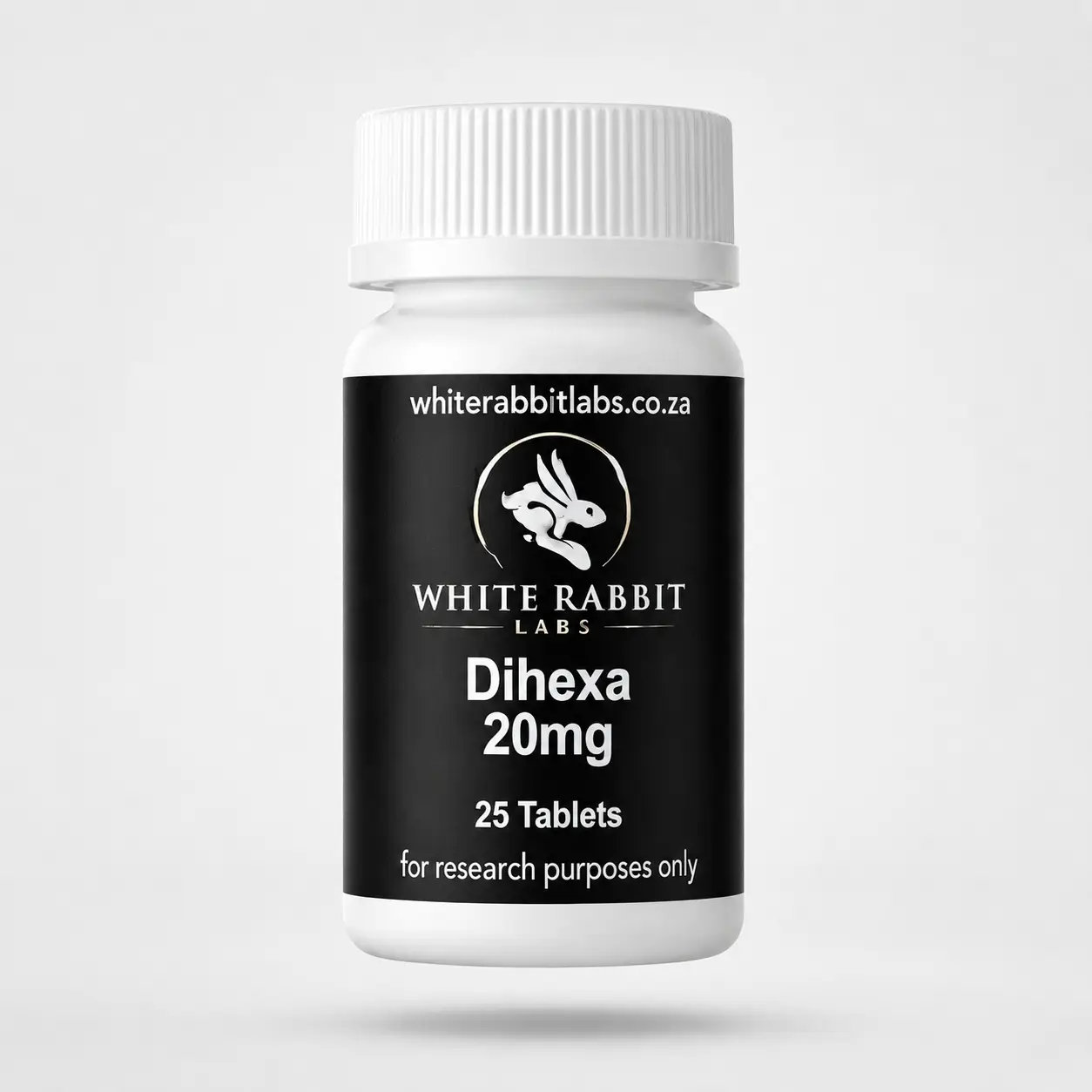
Dihexa 20mg

Out of stock

R2 890,00

Out of stock

Categories: , Tag:

Description

Dihexa is a synthetic peptide-based research compound commonly referenced in laboratory studies involving neurological signalling, synaptic pathway research, and cognitive-response models.

In research settings, Dihexa is often reviewed for its relationship with hepatocyte growth factor pathway activity, synaptic connectivity models, neuronal signalling, and non-clinical neurobiology research.

This product may be relevant for researchers exploring how selected peptide compounds behave within controlled laboratory environments where neurological pathways, cellular communication, and synaptic signalling models are being studied.

Dihexa is intended for qualified research use only and is not positioned as a medicine, supplement, nootropic product, memory product, focus aid, brain-health product, anti-ageing product, or performance enhancer.

Research Context

Dihexa may be of interest in laboratory studies focused on:

  • Neurological pathway research
  • Synaptic signalling models
  • Cognitive-response research models
  • Hepatocyte growth factor pathway activity
  • Neuronal communication studies
  • Cellular response pathways
  • Non-clinical neurobiology research
  • Peptide interaction studies

These references are provided for research context only and must not be understood as human benefit claims.

Important Notice

This product is supplied strictly for laboratory research purposes only. It is not intended for human or animal consumption, injection, nasal use, topical use, medical treatment, cognitive enhancement, memory support, nootropic use, neurological treatment, performance enhancement, or any form of in vivo use.

White Rabbit Labs does not provide dosing, usage, administration, application, reconstitution, or protocol guidance. Buyers are responsible for ensuring that this material is handled only within a suitable research environment and in line with applicable laws, safety standards, and internal laboratory procedures.
What It Is

Dihexa is a lab-made synthetic hexapeptide — a modified 6-amino-acid chain derived from angiotensin IV. It was developed at Washington State University in the early 2010s as a potent activator of the hepatocyte growth factor (HGF)/c-Met system. Unlike most peptides, it’s designed to cross the blood-brain barrier easily and promote massive synaptogenesis (new synaptic connections) — claimed in preclinical research to be up to 10 million times more potent than BDNF (brain-derived neurotrophic factor) for forming functional neural connections.

How It Works

Think of Dihexa as a “synapse-building accelerator.” It supercharges the brain’s ability to form new connections and repair itself under stress or damage.

How it works:

  • Potentiates HGF binding to c-Met receptors.
  • Activates downstream that drive synaptogenesis, neurogenesis, and neuroplasticity while protecting neurons from toxicity (e.g., amyloid-beta in Alzheimer’s models).


Observed Benefits

Main benefits (strongest from preclinical rat/mouse models; no human proof):
• Cognitive enhancement & memory repair — dramatically increases functional synapses; reverses cognitive deficits in Alzheimer’s-like (APP/PS1) mouse models.
• Neuroprotection & recovery — shields neurons from damage in stroke, Parkinson’s, or injury models; supports motor and cognitive recovery.
• Neuroplasticity boost — promotes new neural connections for learning and brain repair.
• Bonus signals: potential in traumatic brain injury and other neurodegenerative conditions.

In short: It helps the brain rewire and heal at an unprecedented level in animal studies — often called one of the most powerful synaptogenic compounds ever tested.

Possible Side Effects

Dihexa has no established human safety profile — all data is preclinical or anecdotal.
In animal studies: Appears well-tolerated with no major toxicity.

Theoretical/mild concerns (from reviews and user reports):

Possible overstimulation (headaches, anxiety, or “wired” feeling).

Reconstitution, Dosage and Cycling (Research Only)

Anecdotal/research range: 25 mg per day (some protocols start lower; oral bioavailability is good).

Frequency: Once daily (often morning for cognitive effects).

Cycling:

  • 4–8 weeks “on,” then 4 weeks off (to assess and prevent any potential adaptation).
  • Many protocols use short courses aligned with cognitive training or recovery periods.
Fun Facts
  • 10 million× BDNF claim — in one assay it was reported as seven orders of magnitude (10,000,000×) more potent than BDNF for forming new synapses.
  • Angiotensin IV derivative — built from a blood-pressure-related fragment but repurposed for brain growth.
  • Synaptogenesis machine — designed to create entirely new functional connections in the brain (hyperplasia at the synaptic level).
  • Alzheimer’s mouse hero — in APP/PS1 models it reversed memory deficits and reduced inflammation via PI3K/AKT.
  • Research-only legend — never advanced to human trials but remains a favorite in nootropic and longevity circles.
  • Blood-brain barrier champion — specially modified to cross into the brain efficiently.
  • Hexapeptide powerhouse — small (6 amino acids) yet one of the strongest synaptogenic compounds studied.


Citations and Sources

Human data = none (no completed trials). All evidence is preclinical (rats/mice) or mechanistic.

American Medical Wellness guide (Aug 2025): Not FDA-approved; mechanism via HGF/c-Met for synaptogenesis; no human trials; anecdotal dosing 10–30 mg/day.

Dihexa.co.uk research hub (2026): Preclinical focus on cognitive enhancement and neurodegeneration;

Alzheimer’s Drug Discovery Foundation report (referenced 2026): Improves cognition and synapses in rat models; no long-term safety data in humans.

Sun et al. (2021 PMC): AngIV-analog Dihexa rescues cognitive impairment in APP/PS1 mice via PI3K/AKT pathway; reduces inflammation and neuronal loss.

Holistic Medical Wellness (2025): Promising preclinical neuroregeneration; lacks human trials; used off-label in some settings under supervision.

Creative Peptides overview (2026): Potentiates HGF/c-Met for synaptic plasticity; potential in Alzheimer’s and neurodegeneration;
Medium / Alghul review (2026): Powerful experimental nootropic; dramatic synapse growth in animals;

Takeaway: Extraordinary preclinical promise for brain repair and cognition, but zero human clinical trials mean it’s still purely experimental.

Our Take

Dihexa is one of the most exciting brain-repair peptides in research — but right now it’s purely experimental. Proven brain-health basics (exercise, sleep, diet) and approved options come first.

Before trialling Dihexa, we firmly believe you should reach out on the supergroup to discuss some protocols that we recommend. It’s highly potent for neuroplasticity so when taking it, make sure you’re at the very top of your game because these habits are what you’re going to cement in your brain.

Disclaimer

Important disclaimer upfront: Dihexa is NOT approved by the FDA (or any major agency) as of 2026. It remains strictly investigational/research chemical with no completed large-scale human clinical trials for safety or efficacy. All data comes from preclinical (animal/cell) studies. Compounded or research-grade versions carry quality risks and are subject to FDA restrictions. Long-term human safety is completely unknown (theoretical concerns include cancer risk or maladaptive brain wiring). It is banned by WADA. Always talk to a doctor — this is not medical advice.